Showing posts with label hydroelectric. Show all posts

Friday, 10 May 2013

Hydro update

The engineers from Spaans Babcock have been on site this week to rectify the design of the bottom bearing.  Here's what remained of it after this recent breakage:
The offending beam has been removed:
 A new plinth has been cast which now holds the new bearing in place.

Monday, 6 May 2013

That hydro electric plant again

 
Disappointment at the hydro-electric plant which has been shut down again for an extended period.  Last year we had a problem with the bottom bearing which blew itself to bits in a way which suggested a design issue; but on the grounds that it could have just been a faulty bearing, we agreed to have the bearing replaced and see what happened.  (Below: what remained of the bearing in 2012).
Well, ten months after the replacement was put in, the problem has returned.  This time, upon inspection it was found that two of the bolts holding the bottom beam upon which the bearing is mounted had sheered off - that's quite a force needed to achieve that, and certainly enough to have caused the damage to the bearing.  What could be causing this?
Our system has the bottom bearing held by a very strong, steel beam (above).  We always had our suspicions about this beam as a design feature - because it is very close to the flights of the screw itself and consequently causes an obstruction to water trying to escape.  This cannot be efficient and as the water falls out of the flight onto the beam, shock waves pass back up through the shaft - these can be felt keenly in the machine room above.  
Have a look below to see the beam causing some serious disruption to exit-flow.
A re-design is required, and so in the coming weeks we shall see a new mounting for the bottom bearing.  

The good news is that it has happened during the first dry spell for months, making the work much easier, and the loss of generation less significant.

Saturday, 7 January 2012

Hydro update - 20MWh and counting

All running well, and pleased to say that we have today exported our 20th Mega-watt hour of electricity.  This means, I gather, that we can generated enough for four average sized homes for a year, and we've only been running for four weeks or so.  Good news, I'd say.

Friday, 9 December 2011

The Turn of the Screw (not Britten)


It was with great excitement that, yesterday afternoon, we were able to witness the first turn of the screw.  Roger Hutton, of Potential Energy, proudly raised the main sluice gates and the turbine eased into action.  This was just a test of course, as the electricity board is still checking a few elements in the connection to the grid but we do expect to be contributing in a small, but nevertheless important, way to the sustainable output of the UK within a week.
All contracted plant is now off site as the civil work was completed on Monday, and it is now just testing, linking up the internet (so we can monitor performance) and work to get the telemetry settings right, all going on inside the 'shed of mystery' by the frightfully clever boffins who understand the wonders within.
So the heavy work is complete.  I will report once again when we begin the landscaping, fencing and aesthetic tidying work; but that will all have to wait until we are in a position to get machinery into the field, which would be impossible at present for the mud.

Sunday, 6 November 2011

Archimedes screw update - sluice gate arrives.

Last time I brought you up to speed to the point where the screw had arrived (all 8 tonnes of it), and we had successfully negotiated the 1 mile journey from the A36 down the hill across fields and along tracks, to its resting place in the ready-prepared concrete cradle:
Since then, the bearings have been connected up, and a shed built on top of the concrete platform in which the gear mechanism and control unit are housed.  This is seriously solid kit.
 The shed:
You might recall that there was a large tree root which needed to be removed from the mill leet wall before repairs to it could be made.  This was the result (it came out with quite a bit of wall attached - all of which will be reused in some project or other).
The enormous 360 excavator gave the remaining stones a hefty shove back into the hole created by the tree roots.
And then shuttering was applied in order to create a concrete replacement to the top half of this wall, which will withstand attack by fast flowing 'torpedo' tree-roots and such much better than the old stone wall would have done.
More shuttering props are added:
 The results were excellent, and the plan is to tie this into the new beam (look back at previous updates from first weeks of the project) on the weir to give greater strength on the corner by the piles blocking the leet in the image below.
Some significant site tidying went on at this point, and we suffered from our first rain delays.  Fortunately this coincided in part with a delay on the arrival of the all-important sluice gates.  In the image below you can see the sluice gates have been installed finally, and the shed has also received its cladding which tones it down a bit.
We have been astonished at the speed that the entire project has been moving along.  I am touching copious quantities of wood as I write this, but hopefully all will run smoothly for the final fortnight.  Boy, will be pleased to see the project completed - not only because we are excited to generate the electricity, but furthermore because we are experiencing some pretty determined river flows just now, and a flood this month really would set things back!

This was the river taken this morning:


Monday, 31 October 2011

Hydro update (about 2 weeks behind where we really are)

After some weeks, I can update you in pictorial form on the progress of the hydroelectric scheme.  Sorry for the delay during the most exciting phase of the project, but I'm afraid we've had quite a busy time of it down at Iford lately.  Nevertheless, here is the update!

Endless shuttering...
 And this was the shuttering mould (upside down, here, and about half built) for the cradle for the screw itself.
 And then, one Monday morning, the procession arrived:

 The screw weighs about 8 tonnes.
 And it somehow had to go in here:
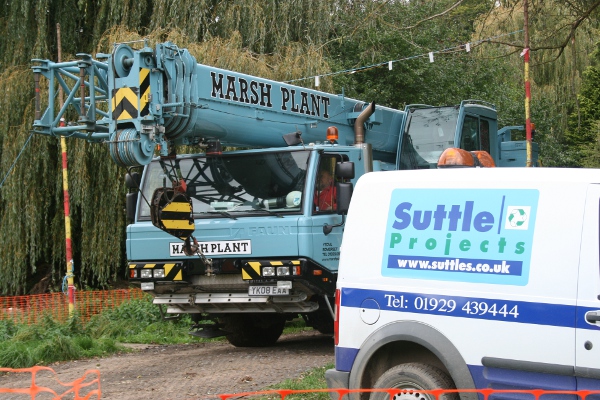
 There was a tree in the way, but this proved no problem for the enormous crane, which simply lifted the steel screw clean over the top of the tree!
 And, at 22 degrees, or thereabouts, the descent into the trough was achieved.


A second update to follow shortly, to bring you up to date with the most recent fortnight, then they were able to put in the gearing system, build a shed to house all the clever control gear, and prepare for the arrival of the great sluice gates and grille for the front.

Sunday, 18 September 2011

Onwards and upwards

Now we're motoring - the weather is starting to be less amenable, and so time is of the essence.  With seemingly endless steel reinforcement going in, the shuttering is being erected in haste to form the frames into which the walls will be poured.  Here are the latest update pictures.


Tuesday, 13 September 2011

Yet more concrete

Apologies to anyone not in fact interested in civil engineering or hydro-electric power... I appreciate that the project has rather taken over the blog as though nothing else is happening at the moment.

I am nevertheless conscious of the wide interest that the hydro scheme has created amongst the local residents, walkers through the valley and visitors alike.  On my walk from the house to my office over the river, I regularly get stopped and asked questions about the scheme, which is great - I'm pleased people are intrigued.

Indeed, yesterday I had a very enjoyable chat with an environmentally involved lady about our shared belief in  using our sustainable natural resources, especially where it doesn't impact negatively on other elements of the environmental system - since this scheme actually enhances the environment, especially for fish, she was very bullish about it.  Encouraging news all round, I'd say.

The photo above is a spot-the-difference with the one from last time, because they managed to get enough of a break in the weather to pour the next load of concrete today - exciting, because it is nearing the big moment when the screw arrives in 4 weeks time or so.

Thursday, 8 September 2011

Bring up the reinforcements...


I really didn't expect to find myself getting this excited about civil engineering... conversations about piling, grades of grit and slump values were liable to leave me pretty cold, I thought.  How wrong I was!


Last week we saw the pouring of the foundation pad for the Archimedean screw.  This week the reinforcing bars have been laid out through which will be poured the main trough (using a fairly dry mix to avoid it slumping down the slope).  This is a make-or-break moment, because if it goes wrong it's a heck of a lot of effort to cut it out again - it's reinforced for a reason, after all...

When looking at the quantity of concrete going in here, it gives an idea of the forces which are being accommodated in the design - this is serious hardware, and a stark reminder of the underlying power of an otherwise tranquil river in spate.

Friday, 2 September 2011

Hydro week 6 or 7

Week 6, week 7, I've lost track rather of where we've got to timewise.  Nevertheless, it was a big week because that big hole that Suttle's had dug previously (where the eel trap used to be) has received its first concrete pad upon which is going to stand the trough to hold the archimedean screw.  You can see the shuttering being constructed to contain the second pouring.

Before:

After:

Whoever said concrete was pouring? (surely, "boring"? Ed.)

Thursday, 25 August 2011

Hydro-electric project: weeks 3, 4 & 5

It has been fascinating to watch the speed with which our civil engineers and contractors, Suttle, have been able to undertake the work.  With a '360' excavator and a dumper truck, you can turn a seemingly solid structure into a hole in a matter of days.  Astonishing.


But first, I mentioned before the need to repair the weir, and to include fish and eel ladders.
The bulk of the repairs are now complete (above, week 3, with the concrete beam half-cast), the fish and eel ladders in place, and the concrete beam which raises the river height a little has now been poured (week 4, below):
I'd say it's a work of modernist beauty - and it's not often I compliment concrete.  It was clear to see that the site manager was proud of the result too, which is always a good sign I think.  Here it is with water flowing over it:

Because the team is now into the phase of construction where they will repair the mill leet, they have shuttered the river such that the weir is now taking the full flow.  And doesn't it look spectacular?
And at the downstream level, work has commenced to create the hole for the enormous trough for the archimedean screw (replacing the former eel trap seeing in the last update's images).  Aggregate was brought in to offer a slipway down to the river, and downstream shuttering now holds back the waters.  Here is the 360 about to drive, with earth-shuddering power, a shuttering pile straight through the gravel, into the river bed.  Thankfully there are very few rocks in the river here, so it's fairly easy going (if you are an excavator that is).
And now, the eel trap has been ripped out, and we just have a large hole developing, into which the concrete trough will be cast.
It is proving to be as intriguing and exciting as we had hoped.

Saturday, 20 August 2011

Hydro-electric project: weeks 1 & 2

##Note: I had intended to post this on 6 August, when I wrote it, but I pushed the wrong button and it ended up in drafts, so it's 2 weeks out of date.  Another update this weekend, therefore, is on its way for week's 3 and 4.##
One of the most exciting projects in the valley is the construction of a hydro-electric plant in the former eel-trap (below) beside the weir (above).
Once complete, the system should generate enough energy to power between 10 and 15 homes (although the electricity will be sold to the grid initially at least) without impacting the local environment negatively at all.

It has always seemed daft to us that we have this powerful resource running through the valley which is essentially unharnessed.  Indeed, the river at Iford has a long history of providing power in the past: originally Iford Mill had an undershot wheel, and it was in the 1930s or so that this was modified to power an early electricity generator.  This was removed in the 1960s since the valley had been added to the grid (to the great satisfaction of residents who no longer had to contend with brown-outs and having to remove sheep, big-bales, and general river detritus from the grille in front of the generator).  And so, after 50 years or so, the river will be returning to work.

For information on the mills in the area, try this excellent book: Wiltshire and Somerset Woollen Mills, Kenneth Rogers
With permissions received and paperwork signed-off, we have excitedly watched as the civil engineering work has begun.  A benefit of this scheme is that it has provided the perfect opportunity to undertake repairs to the weir and mill leet, and whilst the Dutch firm Spaans-Babcock are manufacturing our 10ft diameter Archimedean screw, the repairs are underway first.
Above, the mill leet before clearing, and below a girder bridge is put in to access the weir with heavy plant.
And here's some of the land-based plant with a gratuitous advert for Suttle's, our contractor.
A collapse some years ago through undercutting has been used to create a fish-ladder as requested by the environment agency, and we are also creating an eel-pass which will assist the passage of elvers upstream; these measures should provide a positive benefit to the natural inhabitants of the river through the diversion of much of the water through the screw.
Below, the fish ladder during construction - it looks a lot better after it's finished apparently.
We'll report as the project takes shape, but having had five power cuts in the last three months, it is an exciting prospect to know that self-sufficiency will be just a cable's-run away in the future should we need to resort to that!
Above, the weir, dried out for inspection, before the major work commenced.